Week 9 - Geologic Time
Week 9 - Geologic Time

Introduction
For this week in Science Methods, we talked about the reading Activitymania and how problematic teaching in science can become when we repeatedly have students do activity after activity. In this science model, are students really learning science? How does this approach really benefit student inquiry, which leads to scientific understanding? Us, as teachers, need to think about how we need to not be in control all of the time. Letting students take control of the lesson is perfectly fine.
For our introduction to geology, we learned about how the presidential election of 2012 was impacted by geology. In the Civil War Era, many of the plantations were located in the south due to the fertile land. After the Civil War ended, many African-Americans stayed in the south. Today, the area is heavily democratic, and helped contribute to Obama's re-election.
For our investigation, we were tasked with finding out when specific events on Earth happened: Humans first appearance (Homo Sapiens sapiens), Dinosaurs ruled the earth, first land plants, first land animals, and the creation of the Moon. We were then tasked with placing these events on a geologic timeline. After placing our events on the timeline, we looked at an Earthviewer website (https://www.biointeractive.org/classroom-resources/earthviewer) and covered a specific area area of geologic time.
 |
| Earthviewer |
Towards the end of our lab session, we constructed questions about earthquakes and volcanoes and how they related to plate tectonics.
New Discoveries
We learned that the history of Earth is more complex than we thought. During our discovery, we found out that there was more than one "Ice Age." In fact, there were three times where the Earth was covered in ice - Snowball Earth.
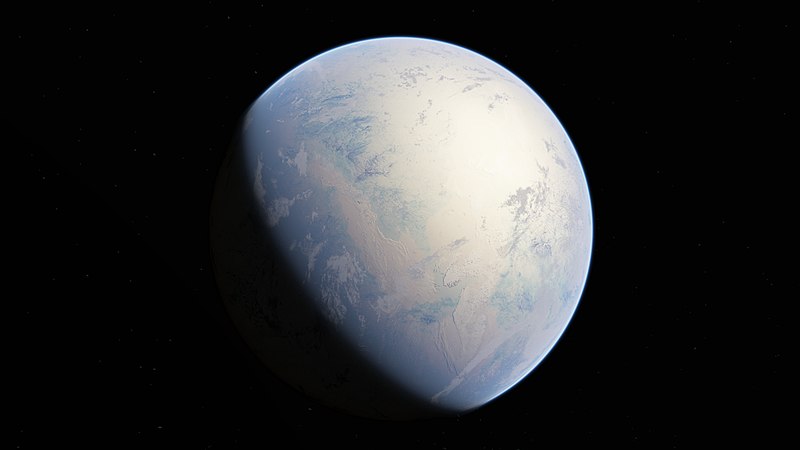 |
| Snowball Earth |
We also learned that humans have not been on Earth for as long as we thought. If we were to look at the history of Earth as a clock, humans only appear at 11:59:40 p.m.
During our discussion, we looked into earthquakes and volcanoes and how they related to plate tectonics. For example, one common misconception is that Hawaii is just formed by erupting volcanoes. This is not entirely the case. In fact, we can explain this with plate tectonics! The Hawaiian Islands were formed by an erupting volcano, but because the plate is moving, the islands were formed by this "hot spot." As the plate moves over the hot spot, the islands slowly form. There is even a new Hawaiian Island being formed right now, but it won't fully be there for a few million years.
 |
| Hawaiian Volcano Hotspot From: National Parks Gallery |
We also explored the idea of continental drift. If we look at the continents, we can see that they fit together like a puzzle. What this means is that a very long time ago, the continents fit together in a supercontinent called Panagea. The continents have slowly moved apart (very slowly).
 |
| Pangea From: Pablo Rodolfo Castro (www.ununicodios.com), CC BY-SA 3.0 <https://creativecommons.org/licenses/by-sa/3.0>, via Wikimedia Commons |
Connections
As seen in our example with geology and the southern states, we learned that domains like Geology can impact other areas like politics! Our investigation also helped us conceptualize how topics like geology and space share a relation. We also learned more in depth on continental drift and how the geologic timeline has led to use looking at plate tectonics, volcanoes, and earthquakes
What's Next?
For next week, we were asked to create a video or any means showing how convection cells work. What is a convection cell? What do these have to do with our understanding of plate tectonics.


Comments
Post a Comment